
Writer- Riddhi Bhardwaj
BA (Hons.) English, 3rd Year
Roll. No.-23/SMEH/ BA (ENG)/041
Department of English
School of Media Studies and Humanities
Manav Rachna International Institute of Research and Studies
Faridabad, India
According to the World Health Organization, over 720,000 people die by suicide every year. Alarming, isn’t it? What makes this even more distressing is that statistics show young people are increasingly vulnerable to mental illnesses and suicide.
We often blame the youth for being fragile, but have we ever paused to consider the deep-rooted factors that may have contributed to this fragility in the first place? The answer, more often than not, is no.
There are three major influences that shape us into the individuals we become: family, society, and environment. In this article, the focus is on society.
When students enter a new college or university, they already navigate a transition by adapting to a new environment, often away from the comfort and support of their families. Society, instead of easing this transition, expects them to ‘fit in’. What we tend to overlook is that most of these students are still in their late teenage years—a confusing, harsh, and emotionally vulnerable phase of life. Their personalities are still developing, their identities still forming.
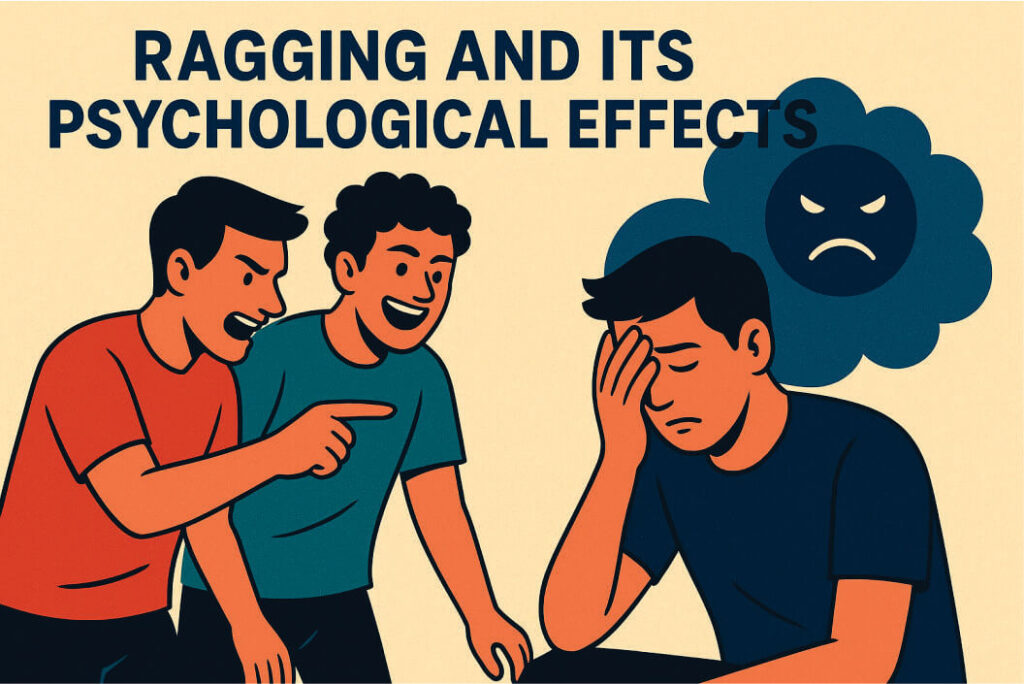
Amid this internal chaos, many are met with an act often disguised as harmless fun but, in reality, is a source of humiliation, harassment, and lasting psychological pain: ragging. Instead of receiving warmth and acceptance, they are subjected to a distorted version of initiation, inflicted by their own seniors. We must question how individuals from the same academic community can turn into perpetrators of their own family members. Understanding this transformation is key to recognizing ragging as a masked monster of society.
All too often, in the name of fun or to satisfy one’s ego, we ignore or neglect the fact that we may be crossing a line. Some may argue that this ‘line’ varies from person to person, and that’s exactly what makes ragging so dangerous. One student might laugh and pass a comment, while another may internalize it as deep humiliation. This subjectivity makes it nearly impossible to define the boundaries—until it’s already too late.
A ragging-free educational campus is not just a legal obligation—it is a moral responsibility of the institution to monitor and to counsel students against such hideous acts. The rising rate of depression, solitude, and suicide amongst youth sends an urgent message: we cannot afford to add ragging to the already heavy burdens young people carry.
Family, society, institutes, friends, peers, and the schools of thoughts must come together to build a structure containing moral bricks not pebbles of unscrupulous and unethical acts.