
Writer- Aaliya Goyal
(Editor- Dr Tripti Tyagi)
BA (Hons.) English, 3rd Year
Roll. No.-23/SMEH/ BA (ENG)/001
Department of English
School of Media Studies and Humanities
Manav Rachna International Institute of Research and Studies
Faridabad, India
“Ragging is not a tradition; it is a crime that kills dignity before it kills lives.”
Ragging is a form of harassment where seniors inflict physical, verbal, or psychological abuse to the newcomers who join the same institution. It is often represented as an ‘ice-breaker’ by senior peer groups but it can easily turn into a source of embarrassment, trauma, solitude, and even death. It can result when green hornscan imagine committing suicide. Ragging violates fundamental human dignity and has no place in a healthy learning environment.
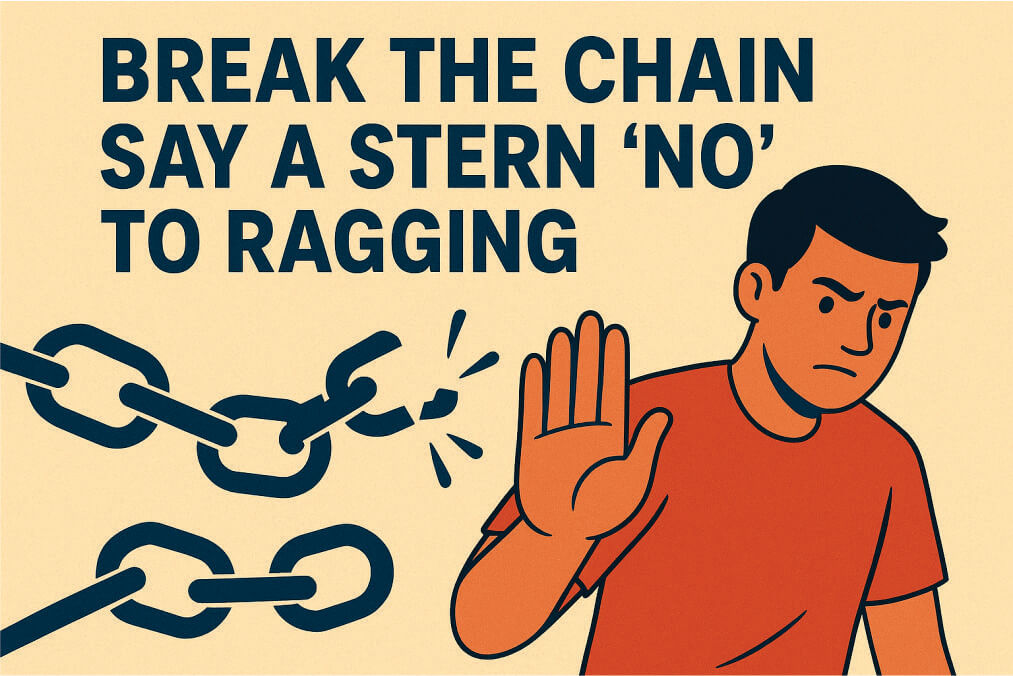
Victims of ragging suffer long-term damage to their academic performance, self-esteem, and mental health. Anxiety, loneliness, and depression are common outcomes. In extreme cases, students are forced to discontinue their studies altogether. The notion that ragging promotes bonding is both dangerous and false.
How can ragging be prevented?
This is one of the most serious concerns for college authorities and students alike. Fortunately, there are several effective measures that institutes and seniors can follow:
- Awareness Campaigns: Orientation programs that encourage seniors and juniors to treat one another with dignity and compassion.
- Strict Enforcement: Offenders should face immediate suspension and legal action.
- Counselling Support: Confidential helplines and professional counselling must be made accessible to victims.
- Student Mentorship Programs: Initiatives that promote healthy interaction and positive guidance instead of coercion.
In response to rising incidents of ragging in India, the government has implemented several regulations. The Supreme Court of India declared ragging a criminal offense in 2001, by announcing it as punishable by imprisonment, fines, and rustication. The UGC Regulations of 2009 mandate anti-ragging declarations from students and parents, formation of anti-ragging committees, and the establishment of 24/7 hotlines. A national anti-ragging helpline also is operational at 1800-180-5522.
Unfortunately, still the consequences of ragging have been faced by some victims. Some victims have laid down their lives. Here are three tragic examples:
- Mihir Ahammed – Kerala (January 2025)
A 15-year-old school boy from Kochi died by suicide after suffering from bullying and ragging at Global Public School. He was subjected to physical abuse and humiliation by other boys. He was forced to go into the washroom. This incident triggered a special investigation by the police. His mother raised this issue with the leadership of the state and approached the high court to find justice for her child.
- Tanya – Uttar Pradesh (June 2023)
A 23-year-old medical student at GSVM Medical College, Kanpur, died by suicide after allegedly being subjected to ragging. Her seniors shaved her head and made fun of her birth defect. Her father grieved that his daughter mentioned them before taking the major step of how she was tortured by her senior students.
Dr. Payal Tadvi – Mumbai (2019)
A postgraduate medical student died by suicide after suffering from constant caste-based harassment from senior colleagues. Her case was known as an act of ragging, and the seniors were charged under the SC/ST Act and the Maharashtra Prohibition of Ragging Act, among others.
Ragging is not a tradition—it is a violation of human rights. Educational institutions should inculcate growth, adoration towards each other, and mutual learning not fear, retaliation, abuse, and harassment. With strict laws, responsible administrators, and a united stand against abuse, we can facilitate the inception of such campuses where every student feels safe and respected.
Ignoring ragging is not just neglecting—it is complicity. It is time we replace cruelty with compassion and intimidation with inclusion.