By Col. (Dr.) Baldev Singh Choudhary
District Sainik Welfare Officer, Shergarh | Educationist | Military Psychologist | Environmentalist | Social Worker
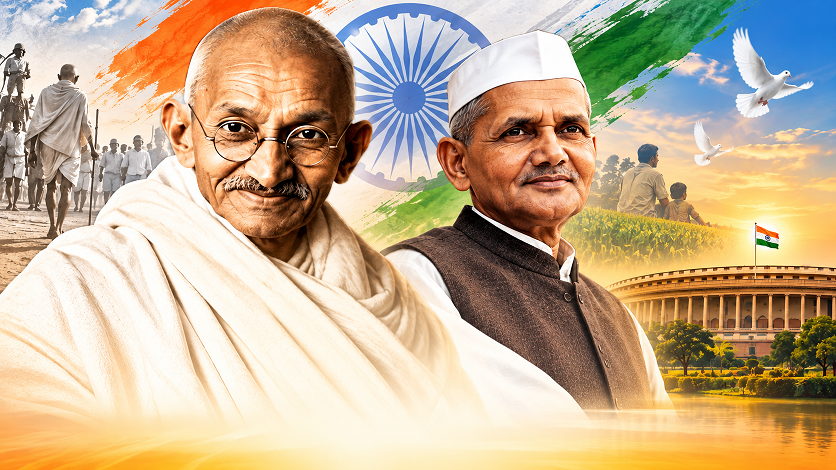
Gandhi and Shastri: India’s Two Golden Role Models for Ethical Public Life and a Stronger Democracy
October 2 is not merely the birth anniversary of two great Indians. It is a reminder of what public life can—and should—be.
India has a remarkable date in its national calendar—October 2. On this day in 1869, Mohandas Karamchand Gandhi was born in Porbandar, and in 1904, Lal Bahadur Shastri was born in Mughalsarai.
One gave the world a profound understanding of the power of truth and non-violence. The other demonstrated, through his own life, the extraordinary strength of simplicity, integrity, humility and responsible governance.
Their personalities were different. Their journeys were different. Their circumstances were different.
Yet, at the heart of their public lives was a common philosophy:
Duty before position.
Responsibility before privilege.
Service before self.
Nation before personal interest.
And perhaps most importantly:
Politics as a means of public service—not as an instrument of personal power.
At a time when democratic institutions across the world are being tested by political polarization, identity-based divisions, declining public trust, excessive political rhetoric, the misuse of public resources and the growing distance between citizens and political institutions, the lives of Gandhi and Shastri deserve to be revisited—not merely commemorated.
Garlanding their portraits once a year is not enough.
Their real tribute would be to bring their values back into public life.
Gandhi: Away from Power, Closest to Truth
For Mahatma Gandhi, politics was never simply a route to power.
It was a means to transform society.
His political philosophy emerged not from the pursuit of office, but from a deep concern for human dignity, justice and the rights of the weakest.
In 1893, at Pietermaritzburg railway station in South Africa, Gandhi—despite possessing a valid first-class ticket—was thrown out of a first-class compartment because of racial discrimination. The Gandhi Heritage Portal records the incident on 31 May 1893.
That night was far more than a personal humiliation.
It became one of the turning points in the life of a man who would eventually develop Satyagraha as a powerful method of confronting injustice.
The man who was thrown out of a railway compartment would eventually demonstrate to the world that injustice could be challenged without hatred and that oppression could be confronted without surrendering one’s humanity.
Gandhi’s South African experience also exposed him to the exploitation and discrimination faced by Indians, including indentured labourers. He campaigned against these injustices and continued to oppose the indentured labour system after returning to India.
From this emerged one of the most important principles of his public philosophy:
A society cannot truly call itself free if the dignity of its weakest members remains insecure.
That principle remains profoundly relevant to modern democracy.
For Gandhi, Truth Was Not a Slogan—It Was a Way of Life
Perhaps Gandhi’s greatest strength was that he tried to apply his principles first to himself.
He did not merely demand sacrifice from others.
The Chauri Chaura incident of 1922 provides a powerful example.
After protesters turned violent and policemen were killed, Gandhi decided to withdraw the Non-Cooperation Movement.
Imagine the political circumstances.
A mass movement was gaining extraordinary momentum. The freedom struggle was at a critical stage. Yet Gandhi was prepared to step back because violence had entered the movement.
That was not political convenience.
It was moral conviction.
His message was clear:
Freedom achieved through hatred and violence could not create the India he envisioned.
In contemporary politics, where winning an argument, defeating an opponent or securing electoral advantage can sometimes overshadow ethical considerations, Gandhi’s example raises a fundamental question:
Should principles be abandoned when they become inconvenient—or should political leadership remain anchored to principles even when the price is high?
Gandhi’s life provides his own answer.
Trusteeship: A Moral Framework for Public Power
Gandhi’s concept of Trusteeship is particularly relevant to contemporary public life.
His basic idea was that wealth, resources and power should not be viewed merely as instruments of personal possession. Those who possess them should regard themselves as trustees and use them with a sense of responsibility towards society.
The concept can extend far beyond economics.
A public representative, minister, civil servant, institutional head or corporate leader can ask a simple question:
“Are the power and resources entrusted to me truly mine—or am I merely their trustee?”
Public money is not personal money.
A government vehicle is not a personal possession.
A public office is not a private entitlement.
Government buildings, institutional resources and public authority are all public trusts.
The spirit of trusteeship therefore demands a culture in which public resources are treated as an amanat—an entrusted responsibility, rather than an opportunity for personal privilege.
This is not merely a Gandhian idea.
It is fundamental to the moral health of any democracy.
15 August 1947: When India Celebrated Freedom, Gandhi Chose to Stand With the Wounded
Perhaps one of the most powerful images of Gandhi’s nationalism comes from 15 August 1947.
India became independent.
But independence arrived alongside the terrible violence of Partition.
While the nation celebrated freedom, Gandhi was not participating in a grand political celebration in Delhi.
He was in Calcutta, amidst communal tension and suffering.
According to the Gandhi Heritage Portal, Gandhi stayed in Beliaghata from August 13 to September 7, 1947, working for communal peace.
For Gandhi, independence was not merely about the departure of the British.
An India in which Hindus and Muslims killed one another could not represent the moral victory he had imagined.
His place, therefore, was with the victims, the frightened and the divided.
That was his nationalism.
A nationalism measured not merely by flags and ceremonies, but by the dignity, safety and fraternity of citizens.
Gandhi and the Frontier Gandhi: A Democracy Beyond Religious and Regional Boundaries
Khan Abdul Ghaffar Khan—widely known in India as the Frontier Gandhi—was one of Gandhi’s closest associates and an important advocate of non-violent resistance.
Their association demonstrated that Gandhi’s vision was never confined by religion, caste, language or geography.
His India was an India where the Hindu was his own, the Muslim was his own, the Sikh was his own, the tribal was his own, the poorest citizen was his own.
The test of nationalism was not identity. It was humanity.
That principle deserves renewed attention in an age when democratic societies can become vulnerable to polarization and identity-based political divisions.
And Then Came Lal Bahadur Shastri: A Giant in Simplicity
If Gandhi elevated the moral dimension of public life, Lal Bahadur Shastri demonstrated how that morality could be lived within political and administrative leadership.
Born on October 2, 1904, Shastri experienced hardship from childhood. According to the official biographical account published by the Prime Minister’s Office, his father died when he was about one and a half years old, and he was brought up under difficult circumstances.
Poverty did not diminish him.
It helped shape his simplicity, discipline and self-respect.
Even after becoming Prime Minister of India, he did not allow power and privilege to transform his personal lifestyle.
Accounts of his life describe his careful distinction between public and private resources, including the well-known episode concerning the purchase of a private car through a loan rather than treating government resources as family property.
The lesson is simple:
Public facilities are responsibilities—not personal entitlements.
That distinction is fundamental to clean governance.
The Railway Accident and the Resignation: Responsibility Beyond Legal Liability
In 1956, following a major railway accident, Lal Bahadur Shastri resigned as Railway Minister.
The official biographical account records that he accepted moral responsibility for the accident and resigned.
Prime Minister Jawaharlal Nehru acknowledged Shastri’s integrity and pointed out that Shastri was not personally responsible for causing the accident. Yet Shastri still believed that the minister responsible for the system had a moral obligation to accept accountability.
This distinction between legal responsibility and moral responsibility is extraordinarily important.
Modern public life often asks:
“Was it personally my fault?”
Shastri’s example asks a larger question:
“What is my moral responsibility for the system entrusted to me?”
That is the essence of accountable leadership.
A mature democracy cannot function only through laws and procedures.
It also requires ethical accountability.
The Expensive Sarees: When a Prime Minister Chose Personal Integrity
Another well-known account from Shastri’s life concerns an invitation to purchase expensive sarees at a textile mill.
He reportedly made it clear that he could not afford such expensive sarees and would not accept them as gifts. Eventually, he purchased sarees according to his means.
The significance of this story is not the price of the sarees.
It is the principle behind the decision.
The office of Prime Minister did not become a passport to personal privilege.
That is the difference between occupying an office and possessing character.
“Jai Jawan, Jai Kisan”: A National Philosophy in Four Words
During the 1965 war and a period of serious food challenges, Shastri gave India the unforgettable call:
“Jai Jawan, Jai Kisan.”
Four simple words captured two essential pillars of national strength.
The soldier protects the country’s borders.
The farmer sustains the country’s people.
Shastri placed both at the centre of national respect.
The power of the slogan came not merely from its words, but from the credibility of the man who spoke them.
His life stood behind his message.
What Can Gandhi and Shastri Teach Indian Politics Today?
India is the world’s largest democracy.
But the true measure of a democracy is not merely the number of voters, elections or political parties.
A truly mature democracy must also cultivate:
Integrity in public life.
Accountability in governance.
Respect for institutions.
Tolerance of disagreement.
Responsible use of public resources.
Dignity for every citizen.
Evidence-based public discourse.
Constitutional values.
And a culture of service.
This is where Gandhi and Shastri become more than historical personalities.
They become ethical reference points for contemporary public life.
Gandhi reminds us:
Do not compromise truth for political convenience.
Never mistake non-violence for weakness.
Put the weakest citizen at the centre of development.
Treat public resources as a trust.
Use wealth and power responsibly.
Never weaponise religion against human beings.
Stand against injustice without hatred.
Respect disagreement without dehumanising the opponent.
Shastri reminds us:
A public office may be powerful, but the person occupying it must remain humble.
Government facilities are not private property.
Leadership requires accountability.
Simplicity is a strength, not a weakness.
Personal conduct must match public promises.
Patriotism is demonstrated through honest performance of duty—not merely through speeches.
India Does Not Need Only New Leaders. It Needs a New Political Culture.
India’s democratic future cannot depend only on changing political personalities.
It also depends on strengthening the culture of public life.
We need representatives who regard public money as a sacred responsibility.
We need administrators who can see the human being behind every file, rule and government scheme.
We need institutions that remain stronger than individuals.
We need political discourse in which disagreement does not automatically become hostility.
We need citizens who demand accountability but also respect constitutional institutions.
We need young Indians who understand that success is not measured only by wealth, position and fame.
Character, credibility, compassion and service must also become measures of success.
And we need business and institutional leaders who understand that resources and influence carry social responsibilities.
This is where Gandhi’s idea of Trusteeship and Shastri’s example of personal integrity converge.
Their combined message could be expressed in four simple principles:
When entrusted with office, do not become the owner—become the trustee.
When given power, do not become arrogant—become more responsible.
When given resources, do not treat them as personal privilege—treat them as public trust.
When something goes wrong, do not search first for an excuse—search first for your responsibility.
The Future of Indian Democracy: From the Largest to the Most Exemplary
India already holds a unique place in the democratic world as the world’s largest democracy.
But our democratic journey should not end with being the largest.
Our aspiration should be to build a democracy that is also deep, resilient, ethical, inclusive, accountable and institutionally strong.
A democracy where political competition does not destroy social harmony.
A democracy where elections are vigorous but constitutional values remain non-negotiable.
A democracy where political opponents can disagree without becoming enemies.
A democracy where public office is understood as a responsibility rather than a privilege.
A democracy where citizens have confidence that institutions exist to serve them.
And a democracy whose functioning can inspire other societies seeking to build stable, inclusive and accountable systems of governance.
The world does not need another political model built around the personality of one individual.
It needs democratic cultures in which institutions are stronger than individuals, principles are stronger than expediency, and public service is stronger than personal ambition.
India has the opportunity to demonstrate such a model.
And Gandhi and Shastri provide two remarkable moral reference points for that journey.
The Real Message of October 2
October 2 gives India two birthdays to remember.
But more importantly, it gives us two questions to ask ourselves:
Can our politics once again become deeply rooted in principles?
Can our public life rediscover the values of integrity, simplicity, accountability and service?
Gandhi demonstrated that an empire could be challenged without weapons.
Shastri demonstrated that the highest political office could be occupied without extravagance.
Gandhi showed the transformative power of truth and non-violence.
Shastri showed the dignity of simplicity, integrity and responsibility.
Therefore, the most meaningful tribute to Gandhi is not merely to garland his statue.
And the most meaningful tribute to Shastri is not merely to place flowers before his portrait.
The real tribute is to read their lives, understand their principles and—most difficult of all—practise those principles in our own lives.
Because a nation does not become great merely through its Constitution, Parliament, governments or institutions.
Ultimately, a nation becomes great through the character of its citizens and the integrity of those entrusted with public responsibility.
India has never suffered from a shortage of ideals.
What we need is the courage to live them.
On this October 2, let us therefore remember two men who chose service over self, responsibility over privilege and character over convenience.
Mahatma Gandhi and Lal Bahadur Shastri.
Two births.
Two personalities.
Two different journeys.
But one common destination—PUBLIC SERVICE.
Truth.
Simplicity.
Self-respect.
Integrity.
Accountability.
And India.
That is the deeper message of October 2.
And perhaps the most important lesson for the future of Indian democracy is this:
The strength of a democracy is ultimately measured not by the power of its politicians, but by the integrity of its public life.
…( Dr) Baldev Singh Manav, a retired Army officer, presently,Zila sainik kalyan adhikari, shergarh, jodhpur, Rajasthan. An educationist, Columnist, environmentalist, social worker and an international transformative motivational speaker