Literature has always been a mirror to society, reflecting its values, beliefs, and social structures. For a long time, however, the mirror mostly reflected the perspectives of men. Aspects like women’s voices, experiences, and struggles were often ignored or misrepresented in literature. Women were expected to remain silent, confined to domestic spaces, and discouraged from expressing their opinions publicly. In this light, women’s writing became a powerful tool for women to share their stories and fight social inequalities. Over the years, women writers have used literature not only as a means of expressing their feelings and experiences but also as a medium to question the patriarchal norms and fight for gender equality.
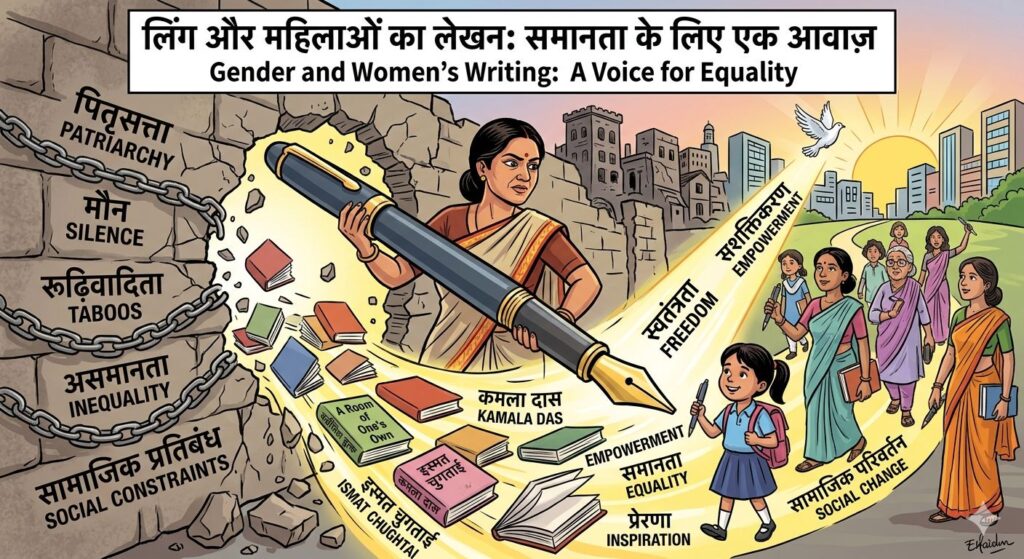
The rise of women’s writing is inextricably tied to larger struggles for women’s rights and education. Women’s education and access to public life opened a door for them to write about their experiences and opinions. Women writers were often attacked and socially constrained in the beginning; writing was not considered a proper profession for women. Many women, however, continued to write and publish in the face of these obstacles, gradually making space for women’s voices in literature.
Virginia Woolf is one of the most important women writers and stresses the importance of independence and creativity for women writers. In her well-known essay, “A Room of One’s Own”, she contended that women required financial independence and a private space in which to write freely. Woolf’s ideas reveal the social and economic barriers that prevent women from participating fully in the literary world.
Ismat Chughtai, one of the Indian writers who contributed in breaking taboos by discussing issues such as female sexuality, social hypocrisy, and gender discrimination. Kamala Das, another famous writer, writes boldly of women’s emotions, desires, and struggles for freedom. Their work challenged conservative social mores and forced readers to face the realities of women’s lives. Their work challenged conservative social mores and forced readers to face the realities of women’s lives.
Indian women writers have contributed a lot to the growth of modern literature. The women’s work exposes the realities of the lives of these women and defies the traditional social norms. In defying traditional expectations of female behaviour, these writers opened space for honest conversations about women’s identities and experiences. Women’s writing is not only about storytelling but also about empowering individuals and communities. In literature, women writers reclaim their voices and challenge the systems that silence them. Their works inspire readers to question existing power structures and advocate for equality.
The creativity of women also inspires younger generations to express themselves creatively and to counter discrimination. Literature’s depiction of women’s challenges and victories moves society towards inclusion and equality. Women’s writing is a powerful movement that has transformed the world of literature. Women writers challenged patriarchal norms and contributed to a more inclusive literary landscape by introducing their unique experiences and perspectives. Their work reminds us that literature is not merely a vehicle for storytelling but a medium through which consciousness and social change can be effected. The literature emphasizes women’s achievements and difficulties to motivate society towards inclusiveness and equality. The women’s movement in writing has had a powerful effect on the face of literature. Women writers have articulated their own experiences and perspectives and questioned patriarchal traditions, contributing to the development of a more diverse literary culture. Their works remind us that literature is not just a medium of telling stories but is also a tool for social awareness and change. As more women continue to share their voices through writing, women’s literature will remain a vital force in promoting equality and celebrating the diversity of human experiences.

By: Sneha Sharma
23/SMEH/BA(ENG)/048
6th SEMESTER
Department of English, SMEH